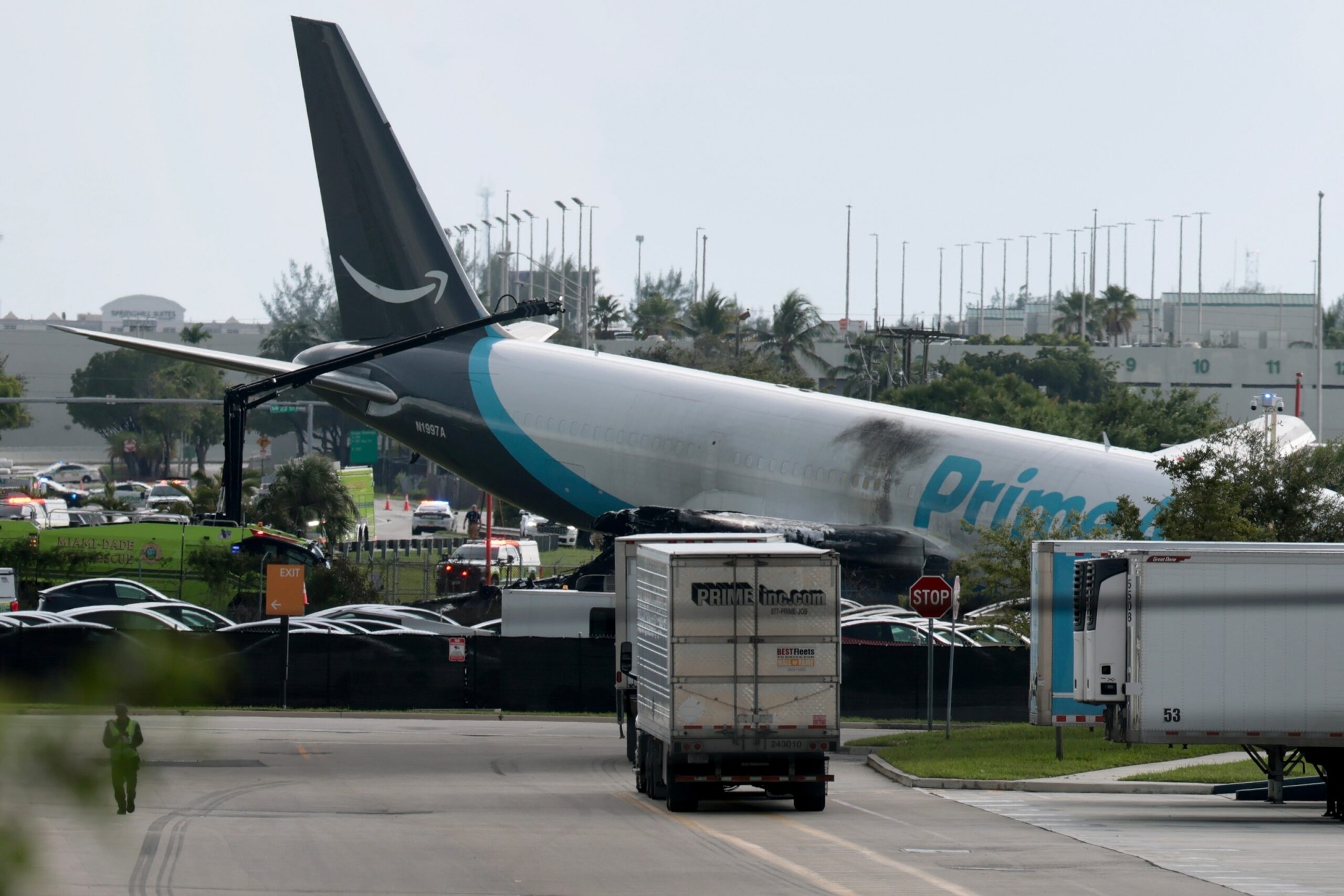
Five people are dead and five others are hospitalized after an Amazon-branded cargo plane crashed at Miami International Airport on Sunday, September 6, 2026. The incident marks one of the most severe aviation accidents involving a major global logistics operator in recent years. Authorities and federal agencies, including the Federal Aviation Administration (FAA) and National Transportation Safety Board (NTSB), have launched a comprehensive investigation into the cause of the amazon cargo plane crash miami.
Crash Details and Immediate Response
The Boeing 767-300, operating as Prime Air Flight 7598 and carrying Amazon cargo, was arriving from San Juan, Puerto Rico. At about 2:00 p.m. local time, the plane overran Runway 30 upon landing in clear weather and crashed through an airport barrier, striking several vehicles on a service road adjacent to the airfield (NBC News). Flames and smoke were visible from the wreckage, prompting a rapid response from more than 60 Miami-Dade Fire Rescue units (source: ABC News).
Miami-Dade County Mayor Daniella Levine Cava and Miami-Dade Sheriff Rosie Cordero-Stutz confirmed that five people were killed and five others were transported to local hospitals, including three in critical condition. First responders also managed a hazardous fuel leak and searched for survivors in vehicles crushed by the aircraft impact.
The Aircraft and Its Operator
The aircraft involved was a former passenger jet, delivered in 1994 and later converted to carry cargo. It was operated under contract for Amazon by 21 Air, a logistics company specializing in freight transportation (The New York Times). The specific registration and crew identities were not immediately released pending notification of families and next of kin.
Amazon Air, the e-commerce giant’s rapidly expanding logistics division, has faced growing focus on safety in the wake of surging demand for fast delivery and a larger fleet. While Amazon Air previously reported only one fatal accident — a 2019 crash attributed to pilot error involving a contracted carrier — this Miami event sharply refocuses safety scrutiny on e-commerce-driven air transport networks.
Emergency Operations and Airport Disruption
Upon impact, the plane ignited, quickly engulfing parts of the fuselage in flames and spreading dense smoke that was visible across the airport campus. Firefighters deployed specialized equipment to douse the blaze and secure the scene. The Miami-Dade Fire Rescue department said that about 200 responders were on-site, with technical rescue teams extricating victims from vehicles affected by the crash (NBC Miami).
The airport immediately closed all runways, causing flight delays and cancellations that rippled through regional and national logistics networks. Miami International, one of the busiest cargo hubs in the United States, gradually resumed partial operations as authorities assessed runway damage and initiated repairs. As noted in regulatory statements, two of four runways reopened within hours, but residual delays persisted for passenger and cargo flights throughout Sunday and into Monday.
Investigation and Preliminary Findings
The precise cause of the amazon cargo plane crash miami remains under investigation. FAA and NTSB officials confirmed that “runway excursion” is the lead scenario, meaning the aircraft was unable to stop safely within the boundaries of the runway. Both agencies have dispatched investigative teams to gather flight data recorders, cockpit voice recordings, crew statements, and air traffic control logs. An NTSB briefing on Monday is expected to provide more initial insights (BBC News).
Officials have not released any details on possible mechanical failures, pilot actions, landing speeds, or weather conditions beyond initial confirmation of clear visibility during the landing. The plane struck multiple vehicles after breaching the perimeter, and at least one vehicle required rescue personnel to extricate trapped victims.
Wider Implications for E-Commerce Air Logistics
The crash has reignited debate within aviation and logistics circles about the pressures faced by cargo airlines flying for major online retailers. Rapid expansion, pressure for on-time delivery, and dependence on contracted operators have made safety, maintenance, and crew training focal issues for analysts and regulators. Previous CyberProfi coverage has discussed how digital technologies and real-time analytics are transforming safety and risk management in the supply chain. Still, high-consequence incidents such as the Miami crash highlight persistent vulnerabilities and the need for operational oversight.
This incident may prompt closer scrutiny of contractor relationships, operational limits in major airport environments, and the integration of automated landing technologies to reduce pilot error and runway excursions. It also underscores the vital role of quick emergency response and the resilience of complex airport infrastructures facing catastrophic events. More discussion on technology’s role in aviation management can be found in our business technology section.
FAQs
- What caused the Amazon cargo plane to crash in Miami?
The official cause has not yet been determined. The FAA and NTSB are investigating the runway overrun and will release findings after reviewing flight data and crew testimony. - How many people were hurt in the crash?
Authorities reported five fatalities and five injuries, with three of those injured in critical condition. - Was this the first Amazon Air crash?
While Amazon Air operates many flights, its only prior fatal accident was in 2019. That crash was found to be due to pilot error. - Did airport operations return to normal?
After the crash, Miami International Airport was temporarily closed. Two runways reopened within hours, but delays and cancellations continued into Monday. - What happens next in the investigation?
Federal teams are collecting evidence. The NTSB will brief the media with early findings as soon as preliminary analysis is complete.