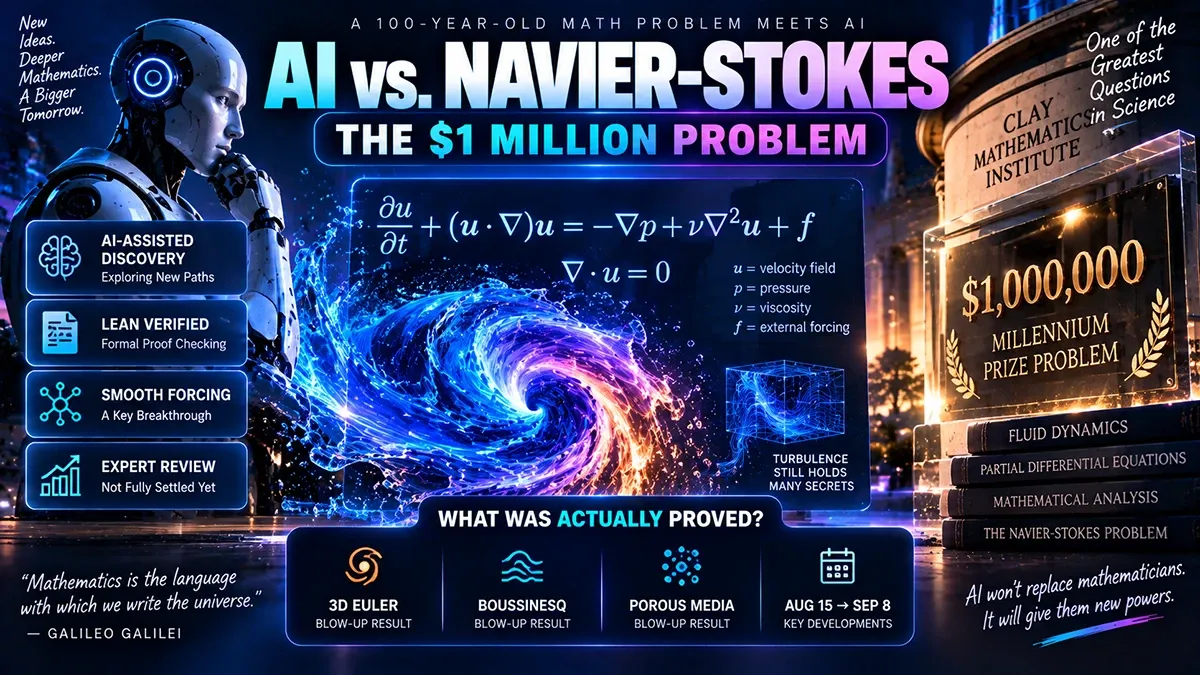
In a dramatic turn for pure mathematics—and the expanding frontier of artificial intelligence—researchers have taken major, AI-assisted steps towards resolving the Navier-Stokes equations, a two-century-old puzzle at the heart of fluid dynamics and the $1 million Millennium Prize challenge. This latest Navier-Stokes artificial intelligence news has sparked worldwide debate not just for its mathematical implications, but also for raising urgent questions about the roles of AI, research ethics, and attribution in mathematical discovery.
The central development: AI and mathematicians approach Navier-Stokes solution
Over the past 24 hours, leading mathematics outlets and mainstream science publications have reported that human mathematicians, collaborating closely with advanced AI systems, have made three crucial advances in attacking the infamous Navier-Stokes problem. The progress, detailed in formal preprints and checked with computer-assisted proof software, centers on special cases of the equations—primarily the related Boussinesq and Euler equations—where singularities or ‘blowups’ in solutions were rigorously demonstrated. These results, many experts suggest, may serve as stepping stones toward a resolution of the full Navier-Stokes question, a feat long thought out of reach.
While full generalization to Navier-Stokes remains unproven for now, an explosion of activity—fuelled by both academic teams and internal proprietary models from companies such as Anthropic and OpenAI—has reset expectations for what AI can help achieve in the mathematical sciences. See more on AI research developments at CyberProfi.
Why the Navier-Stokes problem matters
The Navier-Stokes equations, first developed in the 1800s, underpin much of modern physics and engineering. They describe how fluids (including air and water) move, swirl, and sometimes form turbulence—from weather patterns to aircraft design. Yet mathematicians remain unsure whether smooth, well-behaved solutions always exist in three dimensions, or if solutions can break down into unpredictable ‘blowups.’ The Clay Mathematics Institute lists this among its six unsolved Millennium Problems, with $1 million promised for a solution, and technological as well as scientific stakes have grown as fields from climate modeling to industrial design depend on robust computational fluid models.
Key milestones: The AI-mathematician collaboration
- August–September 2026: Mathematicians Tristan Buckmaster (NYU) and Levent Alpöge (Anthropic) release a series of breakthroughs, proving blowup phenomena in the Euler equations and verifying results using the Lean proof assistant. Their findings point a plausible route to a Navier-Stokes solution, though not yet a complete answer.
- September 8, 2026: News outlets, including New Scientist and Scientific American, confirm that two published results (and an as-yet-unpublished hypodissipative Navier-Stokes result) have been computer formalized, though the latter is still awaiting final verification.
- Controversy: Reports surface, including in Kingy AI and Axios, that OpenAI internally claims their new model proved even the full Navier-Stokes result—though the alleged 100-page proof is not yet public, and independent verification is pending. Meanwhile, concerns are raised about attribution, proper use of research data, and the pace at which these claims are being disclosed.
What has—and hasn’t—been solved?
Three main advances are confirmed:
- Rigorous proofs of blowup (failure of smooth solutions) in the related Euler and Boussinesq equations, conducted by Buckmaster and Alpöge with AI assistance. These results are fully published and have been formalized using Lean.
- Evidence and expert assessment (notably by Fields Medalist Terence Tao) that these techniques could, in principle, be extended to the genuine Navier-Stokes equations, though this is not yet achieved.
- A separate, as-yet-unreleased claim by OpenAI that their latest internal “Bel” model solved the full 3D Navier-Stokes finite-time blowup, but with no manuscript or formal verification released for public review.
Independent mathematicians urge caution and call for the open release of all technical details. The Clay Mathematics Institute continues to list the problem as unsolved as of this writing. Further coverage of mathematics breakthroughs at CyberProfi.
Ethics, credit, and AI’s role in future mathematics
Alongside scientific excitement, the breakthrough has prompted deep unease about credit and research conduct. Tristan Buckmaster has called the episode a ‘Deep Blue-Kasparov moment’ for mathematics, referencing the 1997 chess match that marked AI’s entry into competitive chess at the human level. Academic blogs, such as Kingy AI, chronicle disputes over when and how AI-generated insights should be credited, and whether research teams have responsibly handled shared data or private computational drafts.
This shifting landscape compels mathematical journals, institutions, and AI firms to review how human-AI collaborations are documented, peer-reviewed, and attributed. The rapid advancement also raises new technical questions: as AI produces enormous formal proofs (sometimes hundreds of pages long), how can the global community efficiently, transparently, and collectively verify results critical to science and engineering?
What comes next?
- All published findings to date address special cases or related equations. The full Navier-Stokes Millennium problem awaits a released, reviewed solution.
- Leading mathematicians are pressing for open peer review and reproducibility—especially for high-profile AI-generated results.
- Stakeholders in AI, mathematics, and academia will urgently revise standards for citation, disclosure, and ethics as computational power accelerates research.
This story will continue to evolve as teams release further details and the mathematics community weighs in on the validity—and governance—of AI-contributed proofs.
Frequently Asked Questions
- What is the importance of the Navier-Stokes equations?
- They underpin mathematical models for fluid motion in physics, engineering, and technology, making their full solution pivotal for science and industry.
- Has the Navier-Stokes Millennium Prize problem been solved?
- No. New results have solved related problems and inspired methods for progress, but the principal question remains unsolved pending peer-reviewed, open evidence.
- How was artificial intelligence involved in these breakthroughs?
- AI assisted mathematicians in generating, checking, and formalizing potential proofs, substantially accelerating mathematical exploration and verification.
- What are the major controversies or ethical issues?
- There are disputes over credit, timing of disclosures, and responsible use of research data as humans and AI collaborate closely in discovery.
- Where can I track further updates on this story?
- Follow updates in the Artificial Intelligence and Tech News sections on CyberProfi, and via official statements from Clay Mathematics Institute, major peer-reviewed journals, and the mathematicians involved.
Sources
- New Scientist – Major breakthrough made on famous Millennium maths problem
- Kingy AI – Navier–Stokes and AI: What Is Proved, Claimed and Unknown
- SSBCrack News – AI Claims Breakthrough in Solving Longstanding Navier-Stokes Equations, Sparking Controversy
- Scientific American – AI may have just solved a million-dollar math problem
- Axios – OpenAI’s historic math solution overshadowed by credit controversy